The Country Pantry: From Store Cupboard to Household Room
The country pantry changed with household routines. See what belongs in a pantry today, where to place it and how to make the room earn its keep.
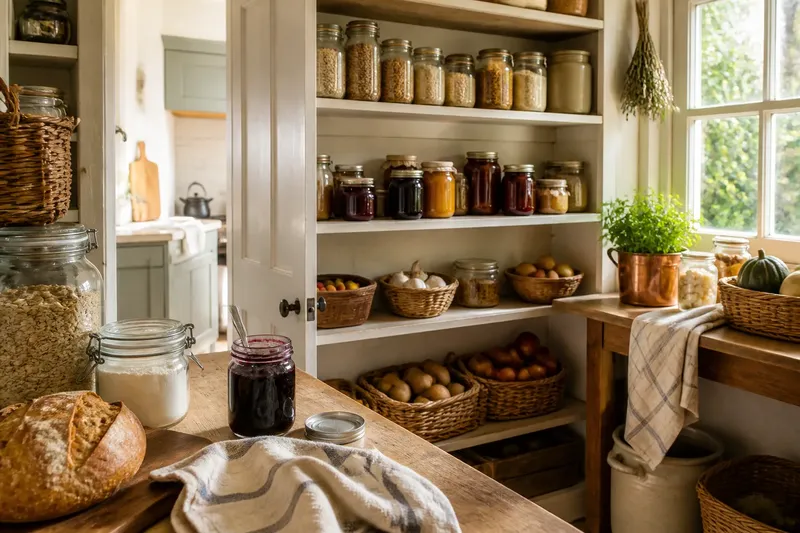
A jar of blackberry jam comes off the shelf, a loaf lands on the worktop, and someone reaches past the flour for a clean tea towel. In a country house, those small errands once made the pantry a busy working room, not simply a cupboard for provisions. The country pantry still answers a practical question: does your household need a place for food alone, or a room that helps several daily routines run more easily?
The answer depends less on a traditional floor plan than on what happens between shopping, cooking and serving. A shallow cupboard may suit a compact kitchen; a separate room can earn its place where a household stores home-grown produce, prepares food in batches or needs a landing space away from the main kitchen. The useful choice is the one that fits those habits without turning the pantry into a catch-all.
A pantry followed the work of the household
The country pantry grew out of domestic necessity. Before kitchen storage became part of fitted cabinetry, a cool, orderly space helped keep dry goods, preserves and equipment together, and gave food preparation room to happen beyond the busiest part of the kitchen. In larger homes, the pantry might also separate the work of preparing and serving food from the rooms where the household ate or received visitors.
Its contents reflected the household’s rhythms. Flour, oats, salt and tea needed accessible storage; jars and bottles needed shelves; bread needed a dry, convenient place. A stone slab or cool surface could help with tasks that benefited from a cooler spot. Hooks, drawers and a sturdy table made the room work harder than a bare store cupboard.
These features were not a fixed formula. A dairy, larder or scullery might take on some of the pantry’s tasks, depending on the house and local custom. Nor did every household have a separate room. A cupboard near the kitchen could serve the same basic purpose where space was limited. What made a pantry distinct was the concentration of storage and supporting work in one useful place.
As kitchens took on more storage and preparation, many pantries shrank into cabinets or disappeared from the plan. Yet the old idea remains useful: give everyday supplies a sensible home, and give the household a place for the small jobs that otherwise crowd the cooking surface. A modern pantry need not imitate an old country house to borrow that logic.
Choose the pantry that matches your daily pattern
Start with the jobs that recur, rather than with a picture of a room you admire. Consider where food arrives, where it waits, what needs preparing, and which objects repeatedly migrate onto the kitchen counter. Then choose a form that resolves those particular bottlenecks.
- If you cook in a compact kitchen: choose a tall cupboard or a narrow pantry cabinet close to the main worktop. Keep frequently used dry goods at easy reach and reserve less accessible shelves for occasional equipment. This suits a household that wants orderly supplies but has no room for a separate work area.
- If your kitchen opens into the living space: consider a pantry cupboard with doors, or a small room where appliances and bulkier provisions can sit out of view. The point is not to hide every trace of cooking; it is to give the main kitchen a calmer surface when meals are under way.
- If you preserve or store produce: a separate pantry or larder may fit better, especially when jars, baskets and seasonal supplies need distinct places. Think through the storage conditions each food requires. A general pantry is not automatically suitable for every kind of produce.
- If several people prepare food: look for room to work without blocking the route between storage and kitchen. A shelf for ingredients and a clear surface for sorting groceries can make the pantry a useful staging area, provided it does not become a narrow passage everyone must cross.
- If the household mainly needs a place for kitchen extras: a cupboard with internal drawers, baskets or adjustable shelves may be enough. A separate room can add walking and cleaning without improving the routine it is meant to serve.
Imagine a household that cooks most evenings, buys flour and pulses in larger bags, and has no spare room beside the kitchen. A tall cabinet with labelled containers, a lower pull-out basket for heavy bags and a shelf for the bread tin would make sense; a walk-in pantry would take space without adding a separate task. If that same household later starts preserving garden fruit, the storage problem changes, and a dedicated cool space may become more useful.
Give each pantry a clear set of jobs
A pantry works best when its contents support a recognisable routine. Dry ingredients can sit near the kitchen route; baking tins and mixing bowls can share a zone; jars of preserves can be grouped together rather than scattered across shelves. If there is a work surface, keep it for tasks such as sorting shopping, filling containers or laying out ingredients—not as a permanent parking place for mail and stray household items.
Storage should suit the things being stored. Strong shelves can carry heavier jars and tins; shallow drawers make small packets easier to see; baskets can gather onions or potatoes where the conditions are appropriate. Clear containers help identify contents, but original packaging can carry useful cooking and storage information. Keep that information available when decanting, and follow the food label and maker’s directions where they apply.
Plan the room around reach as well as capacity. Put everyday tea, oats or cooking staples where a person can take them without moving a tower of less-used items. Keep heavy containers low, and leave enough clear space to set down a basket or shopping bag. A pantry that holds a great deal but makes every ordinary item awkward to retrieve has been arranged for storage, not for living.
For a separate room, account for its relationship to the kitchen. A door close to the cooking area can shorten repeated trips; a room at the far end of the house may be better suited to occasional overflow than to daily ingredients. A worktop is useful only if there is enough room to stand and use it. Shelves alone may be the more comfortable choice in a small pantry.
Keep the purpose visible. One shelf for baking, one for breakfast supplies and a designated place for preserved food can be enough structure. The arrangement need not be rigid: it should make it easy to notice when something is running low and to return items to their homes.
Separate the pantry from the larder and scullery
The terms overlap in everyday speech, but they point to different emphases. A pantry is chiefly associated with provisions and the tasks around storing and preparing them. A larder traditionally gives particular attention to food storage, especially provisions that benefit from cooler conditions. A scullery is more closely associated with washing up and messier kitchen work.
In an old house, one room may have served several of these purposes, while another household kept them apart. Modern layouts do the same in different ways: a pantry cabinet may sit inside a kitchen, a utility room may take on scullery work, and a separate food cupboard may provide the storage function. The label matters less than whether the space suits its contents.
Do not assume that a traditional-looking pantry is naturally cool, dry or suitable for every stored food. Sunlight, heat from appliances, moisture and changes in temperature can all affect the conditions. Observe the room through ordinary use and choose storage locations accordingly. For foods with specific handling requirements, use the guidance on their packaging rather than relying on the room’s name.
Which pantry suits your household?
Can a pantry be just a cupboard?
Yes. A cupboard can perform the pantry’s central job if it gives food and kitchen supplies an organised, convenient home. It suits households that need storage more than extra preparation space.
Does a pantry need to be cool?
Not every pantry is a larder, and ordinary dry goods do not all call for the same conditions. Choose a suitable location for each food, keeping its packaging guidance in view rather than assuming a pantry room is cool by definition.
What should go in a country pantry?
Keep items there that support its chosen purpose: perhaps dry ingredients, bread, preserves, baking equipment or baskets for suitable produce. Leave cleaning products and unrelated household clutter elsewhere so food storage remains easy to manage.
Is a walk-in pantry worth the space?
It can suit a household with enough room and regular storage or preparation tasks that benefit from a separate area. If you mainly need somewhere for tins and packets, a well-arranged cupboard may serve those needs without sacrificing floor space.
Let the pantry change as household habits change
A pantry does not need to be settled once and for all. A household may move from a simple cupboard to a larger store as cooking, preserving or shopping habits shift; it may also reclaim an underused room for another purpose. Review the space when shelves are difficult to reach, supplies repeatedly spill into the kitchen, or a work surface no longer serves any regular task.
Make changes in small, observable ways. Move frequently used ingredients nearer the kitchen, remove containers that no longer suit their contents, or reserve a shelf for the seasonal supplies that currently need a home. If a separate room stays empty except for occasional overflow, its best role may be storage rather than preparation. The country pantry is most convincing when it reflects the household that uses it now.
For a country pantry that earns its space, begin with the daily route from provisions to preparation, then choose only the storage and work surfaces that make that route easier. Leave one clear place to set down groceries: it is a modest detail, but it gives the room a useful welcome every time the shopping comes in.